Friday, March 14, 2014

Woodcocks During the Day

     After the successful timberdoodling in my backyard for the paste few days, I went out to try and find these incredibly well camouflaged birds during the day so I could get a better picture.  During the day they rarely move, but they let you get very close.  This makes it much harder to see them. 
     Since I knew where they were I headed to the area where they generally had been displaying in the night.  In about five minutes  I came to a clearing in the thicket and stopped to look around.  I looked down a promising deer path surrounded by heavy brush.  I did not see anything so I looked in another direction.  After a minute or two I looked back down the path to see a Woodcock sitting absolutely still in the middle of the path.  I couldn't believe that I was standing only five feet away from an American Woodcock!
American Woodcock

American Woodcock


     After admiring this bird for about twenty minutes before it walked into thicker brush, I brought my mom and little brother out to see it also.  Sadly we did not see this bird.  However we kept looking in other spots and saw another Woodcock bob-walking into the thicket from a field on the other side.  We were lucky enough to see that same Woodcock from the other side of the thicket after it walked into the thicket after seeing it walk into the thicket too.
Second Woodcock behind brush

Second Woodcock sitting down


     After seeing the second Woodcock with my mom and brother, my aunt was lucky enough to have seen it in the same spot.


Wednesday, March 12, 2014

Duck Migration at the Churchville Nature Center and Looking for Woodcocks in my Backyard

     As soon as I got home from school, my mom took me to the Churchville Nature Center to have a chance to see and photograph a male Canvasback.  We arrived at the location where all the ducks were being seen at the nature center.  I immediately hopped out of the car and crept up to the water.  The waters edge was covered by Common Mergansers and Ring-necked Ducks.  Out farther on the lake was the male Canvasback.  I sat down at the edge of the lake and started to take pictures of all of the duck species. 
Male Canvasback

Male and Female Lesser Scaup

Male Common Merganser

Male Ring-necked Duck


     While I was photographing the Canvasback, two male Hooded Mergansers swam out in front of me showing off their beautiful black and white head plumage. 
Hooded Mergansers

Hooded Mergansers

Hooded Mergansers


     When we got home I had known from past experience that there were American Woodcocks that do their mating dance in my backyard around the beginning of March.  I kept opening my back door and peeking my head out for about five minutes to hear if the Woodcocks were "peenting".  This night I was more confident that I would hear them because I had heard cycles of different bird species calling as I had heard in other successful "Woodcock hunts".  First it was silent, following that, it was incredibly active with sparrows and cardinals chipping.  After that, it would be silent again for about three minutes, and then the first Woodcocks would start peenting.  That night, 3/11/14, I heard the first Woodcock at about 7:18 pm.  It is not always the same exact time, but it is generally always around then.  Soon, they would begin to do their flight display, this I have never seen before, but yesterday I did.  Two Woodcocks would fly up very high and hover inches away from each other for a few minutes.  They would then land back on the ground and start the cycle again. 
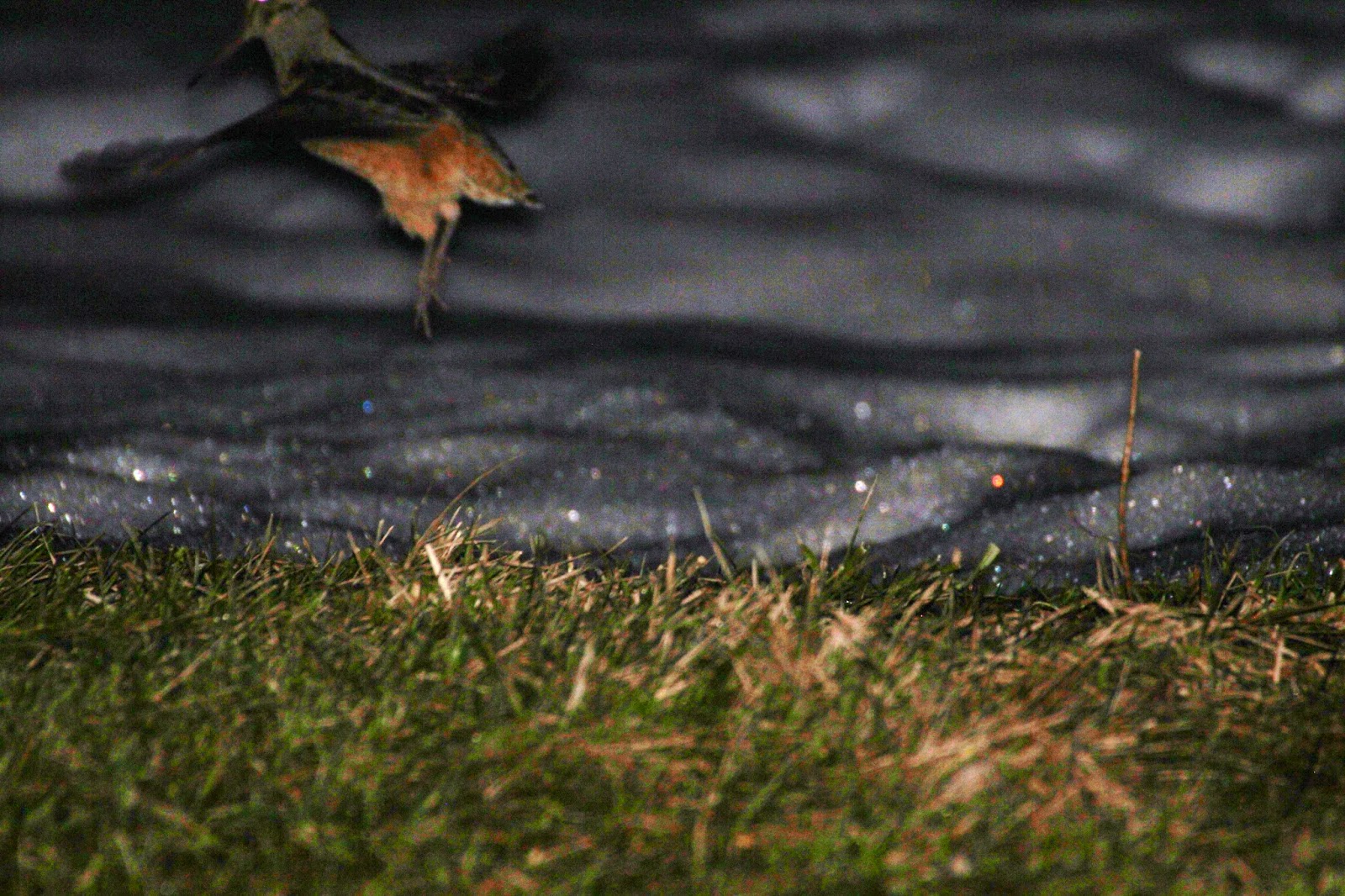
     I have never had a chance to photograph them either because it was always dark when they displayed.  But this time I had my brother come out with me with a flashlight.  With that along with the camera flash, I was able to get a pitch black picture with some eye shine.  However, I brightened it on the computer and could successfully see the bird.
American Woodcock

American Woodcock flying away


Sunday, February 23, 2014

Comparing New to Old Camera Lenses

      These are all pictures from my first trip to Barnegat Lighthouse State Park with my old camera lens (Canon 300mm) and from my most recent trip to Barnegat Lighthouse State Park with my new camera lens (Sigma 500mm).  However I had much better lighting on my second trip, the photo quality is still much better.
      The are my two favorite pictures of Harlequin Ducks from the trips.
Harlequin Duck with new lens

Harlequin Duck with old lens


      These next two pictures are of adult male Long-tailed Ducks.  These photos really show the difference in quality of the two lenses.
Long-tailed Duck with new lens

Long-tailed Duck with old lens


      The difference in photo quality of Red-breasted Mergansers was also very evident.  One with the new lens was clear enough to see the serrations on the beak for firmly holding onto fish.
Red-breasted Merganser with new lens

Red-breasted Merganser zoomed in on beak with new lens

Red-breasted Merganser with old lens


      Finally, I saw a large difference in photo quality of the Common Loons.  With my new lens I was able to zoom in on their beautiful red eye and really appreciate it more.
Common Loon with new lens

Common Loon zoomed in on eye with new lens

Common Loon with old lens


Tuesday, February 18, 2014

A Great Day at Barnegat Lighthouse State Park

      On 2/17/14 my mom, my aunt, my brother and I went to Barnegat Lighthouse State Park for the day.  As soon as we parked in the park's parking lot, we saw a Hermit Thrush on the fence right in front of our car and a few Yellow-rumped Warblers.  As soon as we got on to the jetty, the first bird I saw was an adult female Long-tailed Duck followed by an adult male Red-breasted Merganser.
Yellow-rumped Warbler

Adult female Long-tailed Duck

Adult male Red-breasted Merganser
 
 
      After this, we watched an adult male Surf Scoter fly in and land near us.  We also got good looks at a very close adult female Red-breasted Merganser and a very close adult Common Loon that showed us his spectacular red eye in the sun light.
Female Red-breasted Merganser shaking out its feathers

Female Red-breasted Merganser

Adult Common Loon close to the jetty

Adult Common Loon zoomed on red eye


      Further down the jetty, I saw my first male Long-tailed Duck of the day, but it was only an immature male, and I also spotted a lifer Red-necked Grebe far out off of the jetty.  I soon lost sight of the Red-necked Grebe but kept heading down the jetty.  A few minutes later I saw the Red-necked Grebe again, but this time it was very close to the jetty.  I crept up on the grebe and got only about five to ten feet away from it.
Immature Male Long-tailed Duck

Red-necked Grebe

Red-necked Grebe


      We soon then after saw a large group of Harlequin ducks further down the jetty.  They put on quite a show being only five feet away in the bright sunlight.  They would swim around and splash their wings in the water and hop on and off of the rocks.  I also saw one eating muscles from on a rock.
Harlequin Duck Bathing

Harlequin Duck Swimming

Harlequin Duck Swimming

Harlequin Duck posing on the rocks

Harlequin Duck eating muscles off of the rocks


      Once we got out to the very end of the jetty, I saw only my second and third adult male Long-tailed Duck along with a (new for the day) Horned Grebe and again saw the Red-necked Grebe.  I also finally got a picture of Harlequin Ducks in flight.
Red-necked Grebe (left) Horned Grebe (right)

Adult male Long-tailed Duck

Harlequin Ducks Flying

Harlequin Ducks Flying


      On the way back to the main beach, we saw many Dunlin, a Black-bellied Plover, and a few Brant in shallow pool from the water coming from the ocean seeping through the cracks of the large rocks forming the jetty.  We also saw four White-winged Scoters fly by us to give us all three species of scoter for the day.  I also got great looks of a Great Cormorant and a large flock of Purple Sandpipers.
Dunlin in shallow pool

Dunlin on rocks

Purple Sandpipers

White-winged Scoters

Great Cormorant's blue-green eye
 
Great Cormorant

Black-bellied Plover


      At the end of the day, we finished with 28 species, 8 new birds for the year, and one new lifer.


Sunday, February 16, 2014

The Great Backyard Bird Count

Day:  1

          
        On the first day of the Great Backyard Bird Count, we were only seeing the common species for the first half of the day such as Song Sparrows, White-throated Sparrows, Northern Cardinals, etc.  However, I was still having fun practicing with my new Sigma 50-500mm lens.
Carolina Chickadee making a stop at our Burning Bush before coming to our window feeder.
 
Tufted Titmouse also making a stop at our Burning Bush before coming to our window feeder.
 

        So my mom and I decided to go to Peace Valley Park for a few hours with the good light to try to get a better look at a Red-headed Woodpecker that had been continuously seen there for over two months or to just see a rarer sparrow like a Fox Sparrow or a Tree Sparrow.  That was a total bust.  All of the parking lots were snowed in except for one, and from there on it was very hard to access anything else.  So we went back home and as soon as we look out our back windows my mom notices a larger and darker sparrow.  I crept over and identified it a Fox Sparrow.  A first for the year, and for our backyard!


These are all photos of the Fox Sparrow seen in our snowy backyard eating seeds from on top of our table that we scattered out there.
 
 
Day:  2
 
 
       Although the first day was exciting getting a new year and yard bird, the second day had even more excitement.  Today I woke up early to see if I could get anything different in the morning.  Sadly I did not, but later on at around 10:30 am, our new resident Fox Sparrow came back.
Fox Sparrow with his tongue out eating seeds. 

Fox Sparrow
 
 
       As I was letting my older brother try to take some good pictures with our new lens, he took the picture directly above, I heard a noise coming from the opposite direction.  I turn around and see a Sharp-shinned Hawk tumbling to the ground with a European Starling in its talons!  I tell my brother to turn around and start taking pictures.  After he takes about a dozen photos, I take back the camera and sneak over to a back door closer to the crime scene.  From past experience I know that the hawk will not pay as much attention to me because it is eating.  So I open the door slowly a quietly to get a crisper picture.
Sharp-shinned Hawk guarding his prize.

Sharp-shinned Hawk eating

Sharp-shinned Hawk guarding his prize with his back to us.

Sharp-shinned Hawk with the European Starling still fighting for his life.
 
      Over-all, so far it has been a very exciting Great Backyard Bird Count.